How to Evaluate a Facial Tissue Machine at a Trade Show
A facial tissue machine may appear to run smoothly during a short exhibition demonstration, but buyers need to look beyond the general appearance of the equipment. Folding accuracy, paper compatibility, stack control and downstream handling all affect daily production.
The most useful trade-show evaluation begins with a clear finished-tissue specification.
Check the Paper Feeding System
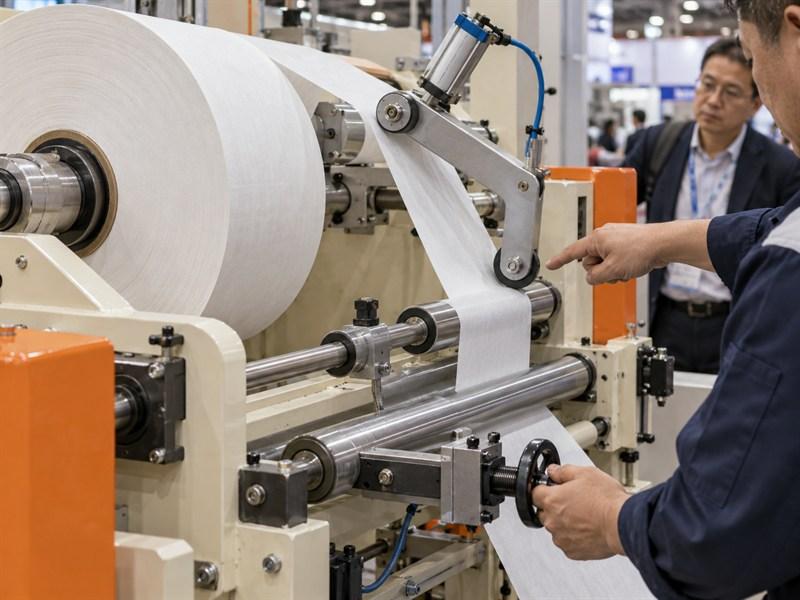
Facial tissue converting starts with stable parent-roll unwinding. Observe how the paper web passes from the roll into the folding section.
The paper should remain aligned and properly tensioned without excessive wrinkles or lateral movement. Ask the supplier which parent-roll widths, diameters, grammages and tissue grades are suitable for the proposed configuration.
If your factory uses different raw-material suppliers, explain the expected variation before requesting a quotation.
Examine the Interfold Quality
The interfolding section determines how smoothly each tissue dispenses from the finished box or soft pack. Examine the output rather than judging the machine only by its operating speed.
Check whether:
-
Fold lines are straight and uniform
-
Sheet edges remain aligned
-
Individual tissues separate correctly
-
The next sheet presents properly after dispensing
-
Stacks remain stable during transfer
-
Paper is damaged or marked during folding
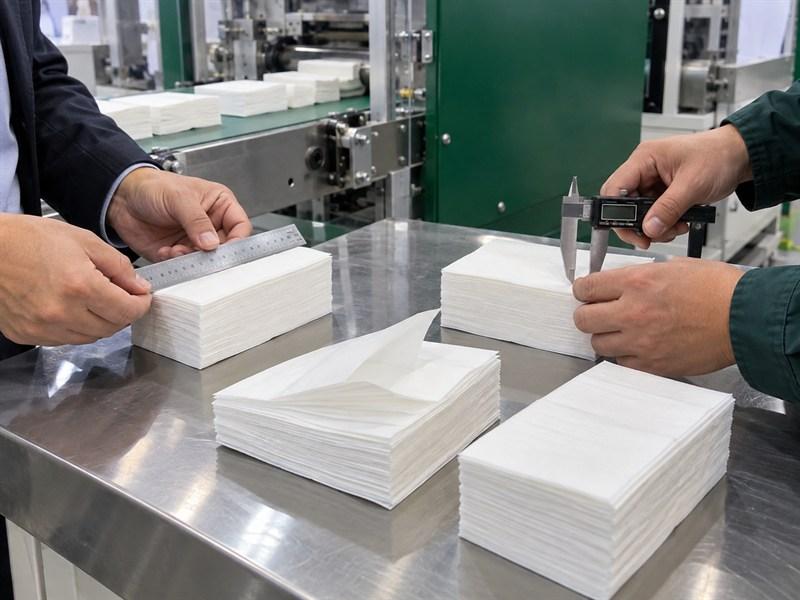
Ask to inspect several finished stacks instead of only the first sample produced.
Confirm Counting and Stack Control
The required sheet count depends on the finished pack. Confirm how the machine controls the number of sheets in each stack and how counted stacks are separated.
For projects involving several pack sizes, ask how the count is adjusted and whether the change can be made through the control system or requires mechanical modification.
Stable stack dimensions are important because irregular stacks can create difficulties during cutting, transfer and packing.
Review Format Changeover
A facial tissue producer may need different sheet sizes, stack heights or packaging formats. Ask which components must be changed or adjusted when switching products.
Important questions include:
-
How long does a normal changeover take?
-
Which settings are stored in the control system?
-
Are folding plates or cutting components replaced?
-
How is the new format tested?
-
How much trial material is normally required?
The suitable configuration depends on the number of products planned for regular production.
Check Downstream Compatibility
The interfolder cannot be evaluated separately from cutting and packing. Confirm how the folded tissue moves into the next stage.
Depending on the project, the equipment may connect with a log saw, stack transfer unit, soft-pack machine or box-packing system. The height, direction and timing of each transfer point must be coordinated.
Buyers planning a complete line should ask for a layout showing every machine, conveyor, operator position and maintenance area.
Discuss Service Before Comparing Price
Clarify installation, commissioning, operator training, spare parts and technical support before comparing offers. A lower equipment price may not represent a lower total project cost if important line components or services are excluded.
For additional project contexts, review our facial tissue machine cases.
Prepare the Right Information Before Requesting a Proposal
To prepare a facial tissue machine proposal, provide the finished sheet size, ply, sheet count, parent-roll specifications, target output, packaging format and available floor space.
If the line will connect to a soft-pack or box-packing stage, review the tissue paper packing machine catalog to confirm which downstream formats and configurations match your project.




 Tel: +86 139 0819 6540
 Email: info@doubletissuemachine.com
 MP/WhatsApp: +86 139 0819 6540
 Manufacturer Address:Dongguan, Guangdong, China