Automatic counting at a napkin machine is only the first part of a pack-count agreement. The buyer also needs to define how a counted group is identified, how it reaches packing intact and how finished packs are arranged in a carton. Write those three boundaries into the proposal. A correct total on the machine display cannot explain a missing sheet after handling, an extra pack in a carton or an incomplete carton after an interruption. Each boundary needs its own visible product condition and a method of checking it.
Agree what the counter is counting
Start with the commercial specification: the napkin format, sheets per retail pack, packs per carton and any planned grouping inside the carton. State whether a “sheet” means one complete napkin after cutting, and distinguish sheet count from ply. A two-ply napkin is still one finished napkin for a pack-count discussion unless the sales specification explicitly defines another convention. Put the convention in writing so that the controller setting, sample count and carton label refer to the same product.
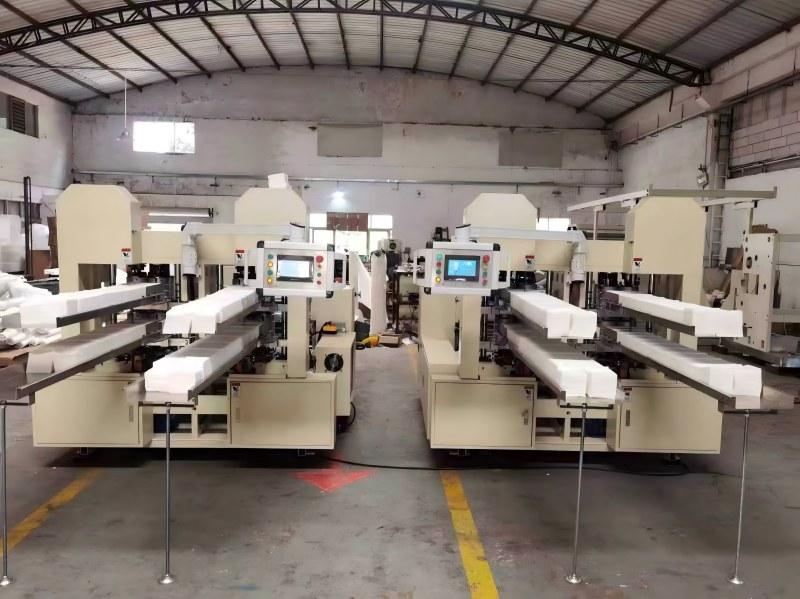
Ask how the displayed production count relates to the physical output. Does it represent one deck, a group of decks or the whole machine? Where more than one count is available, label each one and identify which is used to set the group size. The answer should come from the supplied control and output arrangement. Do not infer it from a photograph of several output decks or from the model's advertised sheet rate.
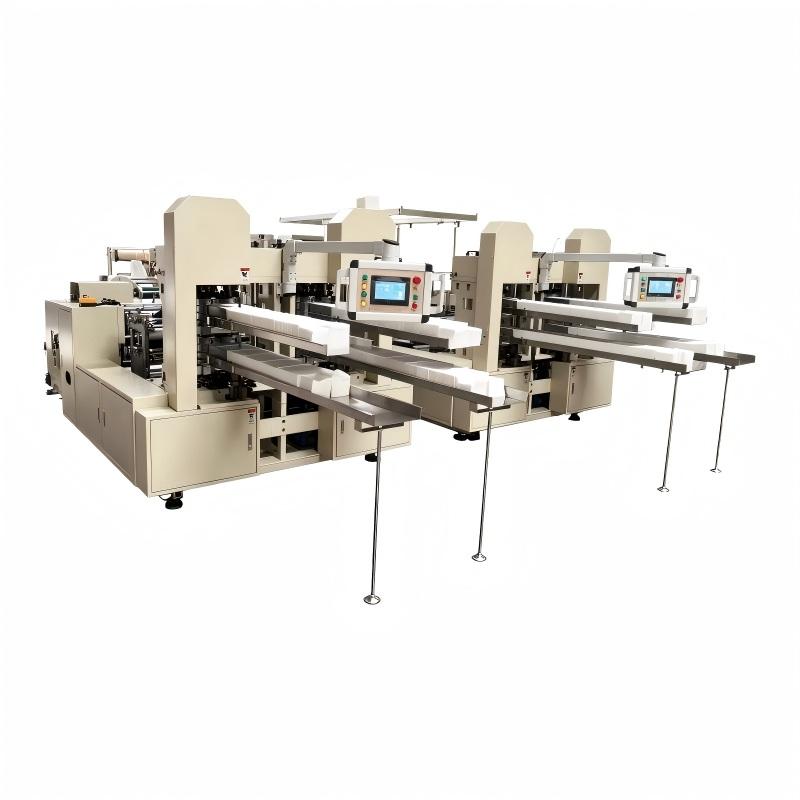
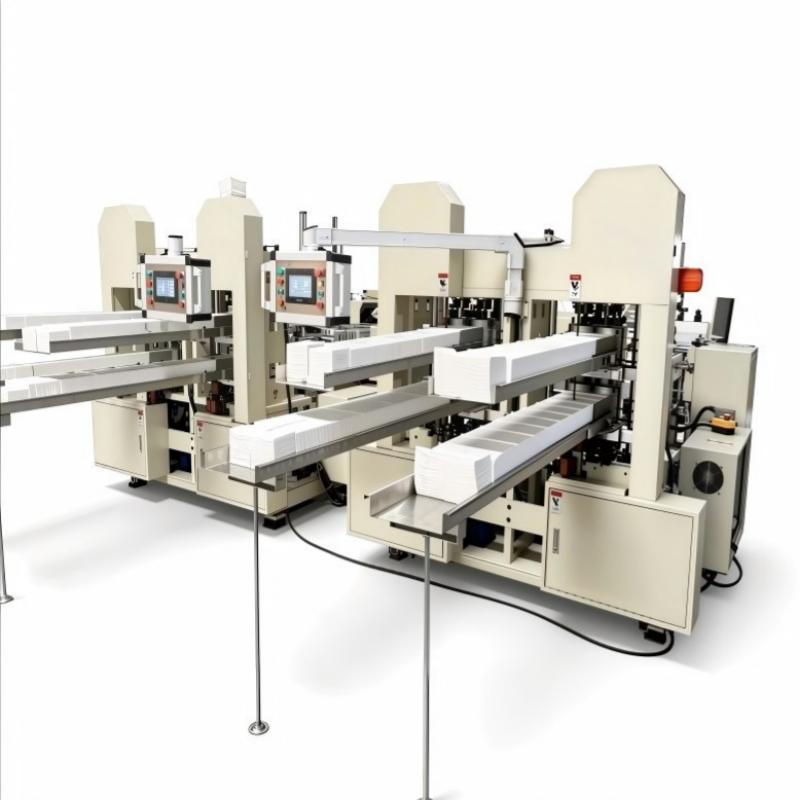
Several output decks make it especially useful to identify the counter scope and the collection method.
Make the end of each group recognizable
The DOUBLE DB-NK-230 listing describes automatic counting and four-deck output, with folding and ring-shape band saw cutting in the converting process. It does not, by itself, specify the method by which a customer's packing section will identify every counted group. Ask the technical proposal to describe that method, including how each deck presents a group and how a handler knows where to separate it.
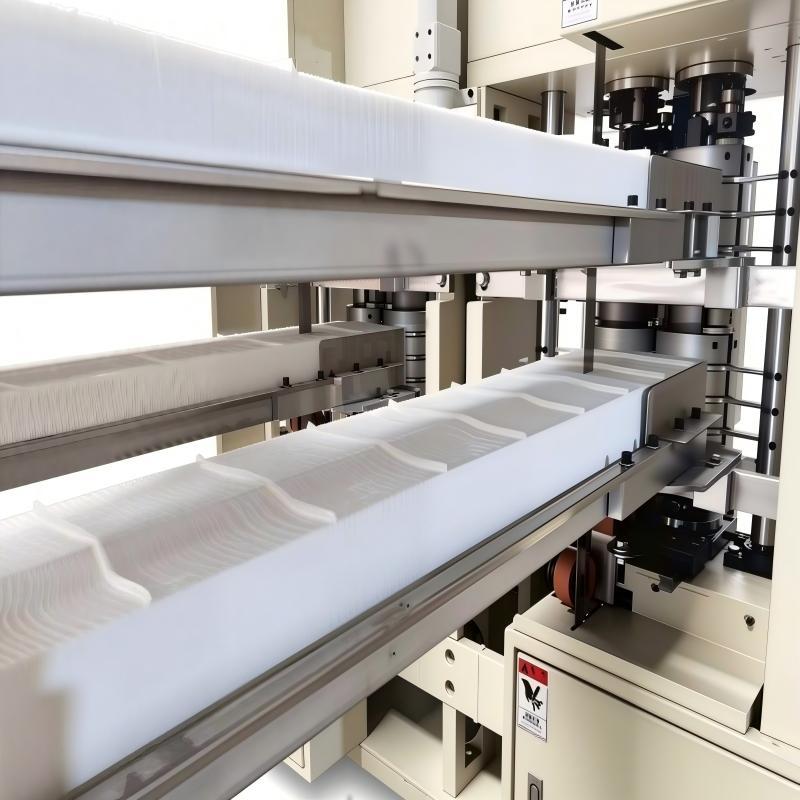
Review the group boundary using the actual napkin and required count. A visible boundary must remain recognizable after the stack settles or is moved. If manual collection is planned, show the operator's collection point and the expected sequence between decks. If automatic separation is proposed, identify the equipment and the receiving condition. These details belong to the handoff specification; they should not be left as an assumption hidden behind the phrase “automatic counting.”
Keep a counted reference stack and label its format and paper grade. Recount it without relying on the machine display. This does not need to become an inspection of every production pack; it establishes whether the group-setting convention produces the intended physical sample during the agreed review. The production inspection frequency and method are a separate agreement.
Follow a group through collection and packing
At discharge: identify the counted group and its deck. Record any partly formed group present when output pauses.
At collection: retain the group orientation and observe whether adjacent groups merge or loose napkins remain behind.
At packing entry: verify the stack presentation accepted by the packer, including dimensions and count convention.
After closure: retain an identified finished pack for the agreed recount or inspection, without treating the package appearance as proof of count.
The purpose is to find where count identity can be lost. A machine may produce a correctly counted group that is then combined with part of another group during transfer. Packing can conceal that error rather than correct it. Trace the same marked group through the sequence during the review, and distinguish a count problem from a stack-alignment or package-closing problem. Each requires a different corrective discussion.
Preserving the identity of a counted group matters between discharge and the closed retail pack.
Draw the carton arrangement independently
Define the carton by its internal arrangement as well as its external dimensions. Record packs per row, rows per layer, number of layers and pack orientation. If the carton uses dividers or another internal element, include it in the sample set. Use actual finished packs for the fit review. An empty carton that matches the drawing may still receive the chosen packs differently from a carton tested with an earlier package size.
A carton count is a count of accepted finished packs. It should not be calculated solely from the folder's accumulated sheet count. Between the folder and the carton, product can be held, rejected or reworked. Specify which finished-pack inspection occurs before cartoning and how rejected packs are separated. Where cartoning is manual, agree the loading pattern and the check for an incomplete carton. Where it is automatic, request confirmation of the proposed cartoning scope and arrangement.
Two distinct approvals: a retail pack containing the agreed number of napkins, and a shipping carton containing the agreed number of accepted retail packs. Passing one does not establish the other.
Decide what happens at a pause
A count agreement needs an interruption case. Ask what happens to a partial group when the machine is stopped for an agreed reason. The control response and the physical product disposition should both be clear. Identify whether the remaining group is completed, removed for checking or handled by another stated method. This is a supplier-reviewed operating condition, not a reason to improvise controller settings during the review.
At the packing side, define how an unclosed or suspect pack is separated from accepted packs before production resumes. At cartoning, identify how an incomplete carton is recognized and completed or rejected. A restart can bring several partially completed units back into the flow at once. Label these units during the review so that the restart record includes the product already present, rather than counting only new output after the machine starts again.
Protect the count when the order changes
Changing the sheet count can alter stack height while leaving the folded napkin footprint unchanged. The new stack should therefore be checked at collection and packing entry. A packing setting that worked with a previous count is not evidence for the revised pack. Similarly, changing packs per carton requires a new carton arrangement even if the retail pack remains identical. Keep these two changes separate in the order documentation.
For a mixed production plan, identify the last group, pack and carton of the old order and the first accepted units of the new order. Record how remaining material is labelled and removed from the wrong product stream. This is also the point to confirm that the pack and carton labels describe the new counts. Mechanical output and printed information need to agree before the new order is released.
Collection access and product identification should appear on the proposed layout, alongside the packing handoff.
Resolve a count disagreement at the smallest boundary
If a finished pack has the wrong count during the review, retain it and identify its discharge deck and collection time where the agreed tracing method allows. Recount a corresponding group before packing and compare the records. The aim is to identify whether the group was wrong at output or changed during collection. Repeatedly altering the machine counter without this comparison can hide a handling error.
For a carton discrepancy, check the accepted-pack count at the cartoning boundary separately from the sheet count inside one pack. A carton with too few packs and a pack with too few napkins are two different failures. Record which occurred and retain the relevant unit. This keeps the corrective action directed at the correct interface and prevents a total production counter from being used to explain every end-of-line discrepancy.
Choose inspection units that can be traced
Agree how sample packs and cartons will be selected and labelled during the acceptance review. Spread the agreed selection across the participating output decks and the relevant operating conditions. A pack taken only from the easiest collection point cannot represent a different collection route. Where a deck or carton format is not demonstrated, record that limitation explicitly.
The review should also identify what happens to opened inspection packs. They must not quietly return to accepted output after their contents have been disturbed. Keep the inspection quantities visible in the output record, alongside rejected and held product. The test then measures the planned product flow without losing track of units removed to verify the count.
Make the handoff reviewable
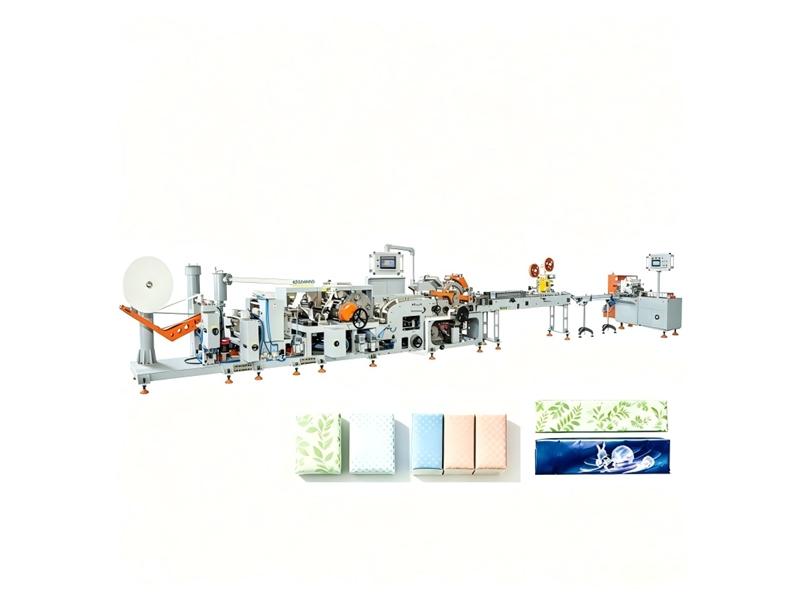
Use the DB-NK-230 napkin paper machine as the converting reference and attach the selected napkin, counted stack, finished pack and carton arrangement to the enquiry. Request a written description of the boundary between each supplied section. If packing or cartoning is outside the supply scope, name the receiving equipment and the party responsible for confirming that interface.
The final record should connect a controller count to an identifiable group, that group to an accepted pack and that pack to a verified carton arrangement. Keep unresolved items specific: for example, group recognition at one deck or the disposition of an incomplete carton. This gives the buyer a practical basis for acceptance and prevents a general statement about machine counting from being used as evidence for the entire end-of-line process.




 Tel: +8613908196540
 Email: info@doubletissuemachine.com
 MP/WhatsApp: +8613908196540
 Manufacturer Address:Dongguan, Guangdong, China