A carton blank needs its own purchasing specification even after the finished tissue box dimensions are approved. The packer must receive, separate and open the supplied blank before loading and closing it. Board identity, crease construction, delivery orientation and glue-area finish therefore belong in the carton order. Treat the approved blank as a controlled production input, with a drawing and a receiving record. Finished-box size alone leaves the carton supplier and the equipment supplier working from different definitions of the same material.
Give the blank a specification separate from the retail box
The finished box drawing defines the package sold to the customer. The blank specification defines the material delivered to the packing operation. Connect the two documents by a common item number, but give the blank its own revision and supplier identity. If only the retail dimensions are recorded, a change to a crease, flap or surface may reach production without appearing to be a product change.
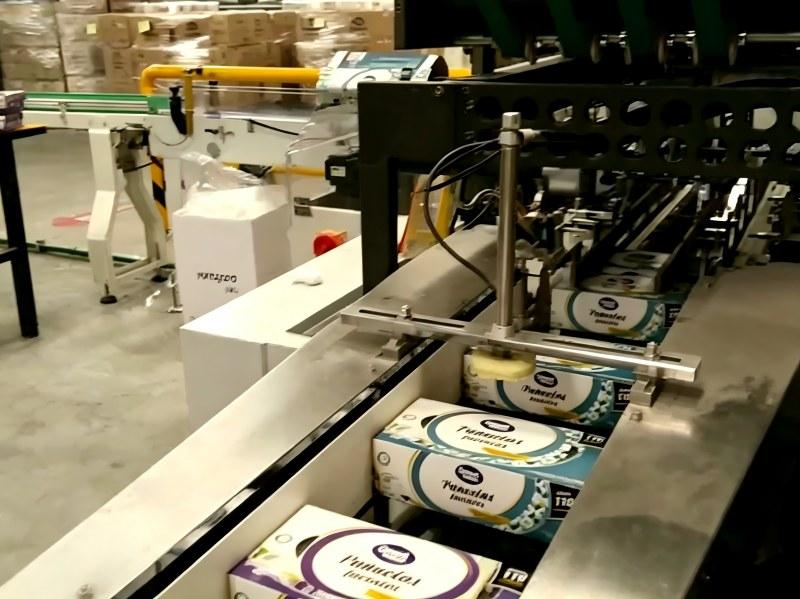
DOUBLE's DB-BF-100B describes automatic box opening, tissue loading and hot-melt glue sealing. Its DB-BF-80B cube-box listing asks for carton board and final box-style confirmation, while the DB-BF-150B identifies rotary suction-cup carton feeding. These published differences are reasons to review a blank with the selected machine. They do not establish interchangeable feeding arrangements across the three models.
Purchasing should request one named blank construction for each approved box format. The specification can refer to the tissue product without repeating the entire stack specification. Its purpose is to control what the carton converter supplies and how that material arrives at the packer, rather than to restart machine selection with every carton delivery.
Issue a flat drawing that can be checked against deliveries
Use the carton supplier's dieline to identify cut edges, creases, flaps, the dispensing opening and any manufacturer's seam. Define the face viewed in the drawing. Mark any pre-glued condition and the way the blank is delivered: flat, folded or otherwise prepared. Ask the machinery supplier to confirm which supplied state its proposal expects.
Retain the dimension convention rather than converting it informally. A crease-to-crease dimension, a flat overall dimension and a formed outside dimension answer different questions. Ask the carton converter to state the inspection points on the blank drawing and ask the machinery supplier which of them matter to feeding and forming. Agree the limits through that joint review; a generic tolerance copied from another carton is not an acceptance specification.
Identify the artwork revision on the same document, including any intentionally unprinted or uncoated area. When a print revision changes only a logo, its effect may be limited to appearance. If it changes a folding or adhesive-contact area, the material review needs to see that difference. Keep technical and artwork revisions traceable without treating them as automatically equivalent changes.
Specify the bundle presented to the carton magazine
Ask how blanks are to be oriented and loaded into the proposed supply arrangement. Mark the intended leading edge and exposed face on the delivery instruction. Confirm whether the carton supplier's bundle orientation matches the machine loading instruction. A carton may have the correct finished dimensions while arriving in a presentation that requires unnecessary unpacking or reversal at the packing station.
This gallery detail shows cups and guides. Their exact sequence and the required blank behaviour must be confirmed for the quoted arrangement.
Discuss the condition of a bundle after its outer wrapping is removed. Ask the carton converter how it controls sticking, curl and damage in supplied blanks, and ask the machinery supplier how these conditions will be reviewed. Do not turn those questions into a claim that the packer automatically corrects every variation. Record the condition accepted for the particular carton order.
Define identification at the bundle level. A supplier item number, revision and batch reference should allow an affected bundle to be distinguished from the remaining stock. State how mixed revisions are handled during replenishment. Operators should not need to infer a blank's version from similar artwork while the machine is waiting for material.
Agree what the carton supplier must show on a delivery label and how the buyer checks it against the purchase order. Keep a received bundle separate when its revision or material identity is uncertain. Similar printed appearance is not sufficient identification. A receiving instruction should direct the buyer to the relevant blank record and name the person who can approve a discrepancy, without encouraging operators to compensate for an unknown material at the machine.
Separate transit damage from a specification change in that record. The first concerns the condition of a delivered batch; the second concerns what the supplier was authorized to manufacture. Photograph and identify either issue before the bundle loses its delivery identity.
Review the board and crease construction together
Request the board grade, supplier reference, declared grammage and thickness information used by the carton converter. Keep the terms and units explicit. The DB-BF-100B public specification includes a carton-board value with a note to confirm the original unit before quotation. That note is a reason to obtain an agreed material specification, not permission to treat a broad listed range as approval of any board.
Ask how the board direction, crease arrangement and manufacturer's seam are controlled for this blank. The machine supplier should review the delivered construction rather than a material name alone. Two blanks described with the same nominal grammage can still need separate review if their construction or finish changes. This is a procurement distinction, not a published tolerance or universal machine limitation.
Keep representative unopened blanks from the reviewed supply, identified by their drawing and batch. Agree a supplier-led assessment of opening and folding behaviour. If a crease is altered, request the revised dieline and the reason for the change. Do not accept an informal instruction to bend every blank by hand as a permanent substitute for the agreed supplied condition.
The published DB-BF-100B workshop photograph shows stacked blanks at the machine. Delivery orientation and replenishment conditions need their own agreement.
Mark the adhesive-contact areas on the blank order
Hot-melt closure is a documented process for these box packers, but the finished seam depends on a reviewed carton and adhesive arrangement. Identify the contacting flap surfaces, any print or coating there and the intended closed appearance. Ask both suppliers to confirm those areas before the carton converter releases production material.
The DB-BF-150B listing says glue application and nozzle configuration can be finalized before production. Keep that configuration tied to the blank revision. The statement does not establish a universal glue pattern, temperature or bond result for other carton constructions. Those details belong in the equipment and material agreement, with the review method specified by the suppliers.
Include responsibility for adhesive selection and supply in the procurement record. A carton surface substitution should not be handled solely as a printing change if it affects a contact area. Hold the altered construction for review and retain the previous specification, so that an observed closure difference can be investigated against a known material change.
The adhesive equipment is shown in the DB-BF-100B gallery. The photograph does not establish compatibility with a particular coating or board grade.
Give a delivery discrepancy a clear decision path
A bundle can arrive with the right artwork but the wrong material revision. Record its supplier item, batch and delivery label against the ordered blank specification before releasing it to production. Identify the actual difference: missing revision identity, altered board, changed crease construction or damage to an otherwise correct supply. That description gives purchasing a specific question to return to the carton converter.
Keep the affected bundles identifiable and compare their delivery record with the purchase order.
Request the carton converter's explanation and the correct drawing or material record for what was supplied.
Obtain the appropriate technical review and buyer decision before accepting a substitution into routine stock.
A missing label may be resolved with verified delivery documentation; a changed adhesive-contact surface may also need the machinery supplier's assessment. Assign those decisions to the people responsible for them. Record whether the supply is accepted, returned or replaced, and update the approved specification only when an actual change is authorized. The next delivery should be checked against that recorded decision, rather than an operator's memory of the previous batch.
Turn the reviewed blank into a receiving instruction
For the DB-BF-100B facial tissue box packing machine, the carton purchase order should identify the approved blank drawing, board reference, revision, bundle presentation and reviewed adhesive-contact surfaces. Add the agreed receiving checks and the person authorized to resolve a deviation. Do not replace that record with a photograph of a finished retail box.
A later board, crease or coating substitution should be visible before the delivery enters routine stock. The carton converter can propose it, the machinery supplier can review its technical effect and the buyer can approve any package change. This keeps the blank supply reproducible while leaving unsupported material compatibility and tolerance claims out of the order.








 Tel: +8613908196540
 Email: info@doubletissuemachine.com
 MP/WhatsApp: +8613908196540
 Manufacturer Address:Dongguan, Guangdong, China