Metres per minute measures how fast paper travels; sheets per minute counts how many finished napkins are produced. They describe different quantities. Connecting them requires the paper advance for one napkin and the confirmed number of parallel product streams, together with a clear counting convention. DOUBLE lists both units for the DB-NK-260 and DB-NK-230, alongside different formats and output arrangements. Read those entries with their configuration details. A web-speed range is not a measured order result, and an output deck is not automatically another multiplier to apply to a published machine capacity.
Separate paper travel from product count
A linear-speed figure tells the buyer how much paper length passes a defined point in a minute. It does not identify how that length becomes individual napkins. A sheet-rate figure counts a defined product at a defined boundary. Before comparing two quotations, establish whether “sheet” means one complete napkin and whether the reported count covers one stream or the entire machine.
Ply needs its own description. A two-ply finished napkin is one napkin under the usual product-count convention, even though two tissue layers form it. If a supplier uses another convention, that convention must be written beside the figure. Counting paper layers as finished napkins would change the apparent output without changing the number of products available to sell.
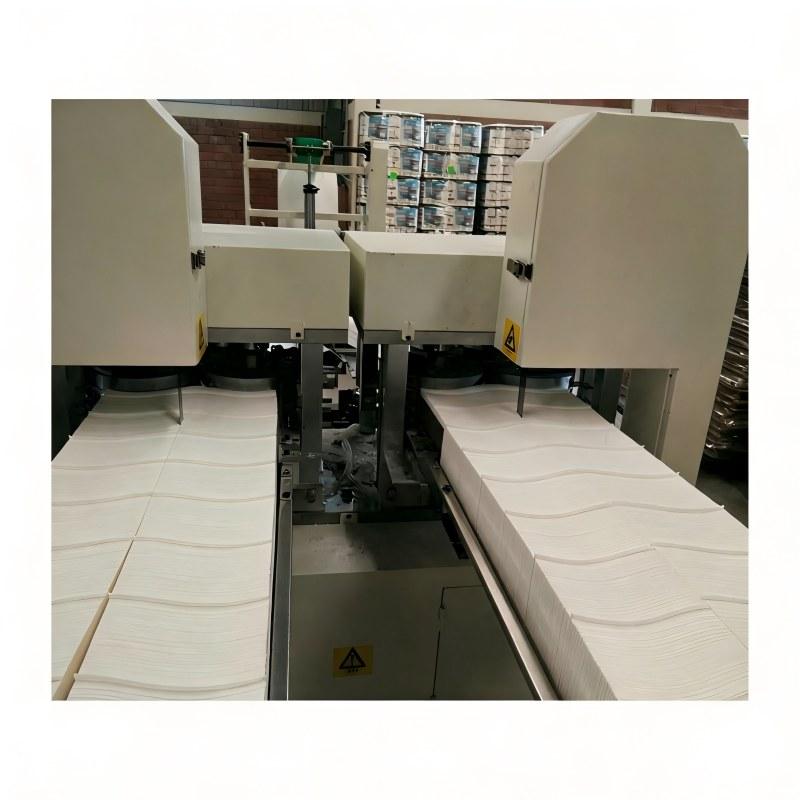
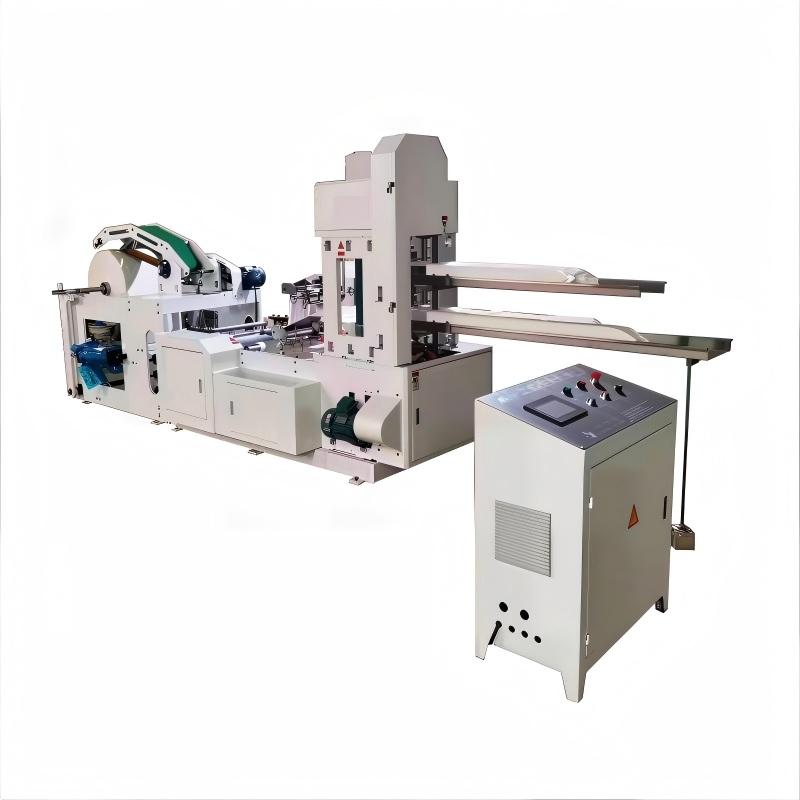
Two visible collection decks do not, by themselves, define the paper advance or the scope of a machine counter.
Keep the measurement point visible in the enquiry. A drive setting, a displayed web speed and a physical product count are separate records unless the supplier explains their relationship. The purpose is to understand what each figure measures before judging which proposal offers more production capacity.
Read the two model entries in their own context
The DB-NK-260 napkin paper machine page lists 200–400 m/min and a capacity entry of 2,000–3,000 sheets/min. It describes quarter-fold napkin production and dual-deck output. The DB-NK-230 page also lists 200–400 m/min, with 4,000–6,000 sheets/min and left and right four-deck output. The identical linear-speed range does not make the two sheet-rate entries contradictory: the product and machine arrangements differ.
These are published product entries, not paired observations from a particular run. The page does not say that the lower end of one range occurred at the lower end of the other, or that the two maxima occurred together. Avoid drawing a straight conversion line between the endpoints. Request a stated relationship for the configuration and napkin being quoted.
The DB-NK-230 specification gives a quarter-fold-compatible 115 mm square folded example but no separate one-sixth finished dimension. That missing format detail also prevents the reader from assigning a universal conversion factor to both named folds. A supplier-confirmed product definition is needed for the selected version.
Use a conversion only when its terms are known
A theoretical counting relationship: sheets per minute = paper travel in metres per minute ÷ paper advance in metres for one napkin × the confirmed number of parallel napkin streams.
This relationship applies only when the supplier confirms what one advance produces and which streams are being counted. It describes theoretical production from that geometry. It does not account for rejected napkins or establish the operating rate that the chosen paper and equipment will achieve. Keep the theoretical result labelled as such.
For an arithmetic illustration unrelated to either listed machine, suppose one counted product requires 0.20 m of paper advance and there is one confirmed stream. At a hypothetical 100 m/min, the calculation gives 500 products/min. A different confirmed advance would change that result at the same linear speed. These assumed values explain the units; they are not a napkin format or operating point proposed for the DB-NK-260 or DB-NK-230.
Use the same length unit in the numerator and denominator. If paper advance is supplied in millimetres, convert it to metres before dividing a metres-per-minute figure by it, or convert both terms to millimetres. Otherwise the calculation can be wrong by a factor of a thousand while still looking like a precise production number. Retain the original dimension and its converted value beside the calculation so that the supplier can check the arithmetic.
The advance belongs to the direction of paper travel. It is not automatically the visible side of the folded napkin. Folding changes the product's presentation, while the counting calculation needs the amount of incoming paper assigned to each complete napkin. Have the supplier mark that dimension and the product streams on its process explanation instead of choosing a convenient dimension from the finished sample.
The roll-width figures on a specification sheet also need context. Dividing a parent-roll width by a napkin dimension can suggest a possible arrangement, but it does not confirm the supplied stream count, edge allowances or cutting layout. Use the actual proposed configuration in the calculation. Arithmetic cannot supply mechanical details missing from the offer.
The reverse calculation has the same limitation. Dividing a published linear speed by a published sheet rate does not reveal a finished napkin dimension unless the stream count, rate pairing and counting basis are known. A number obtained that way may combine several unknowns. Request the missing configuration explanation rather than turning the quotient into an assumed sheet length for the order.
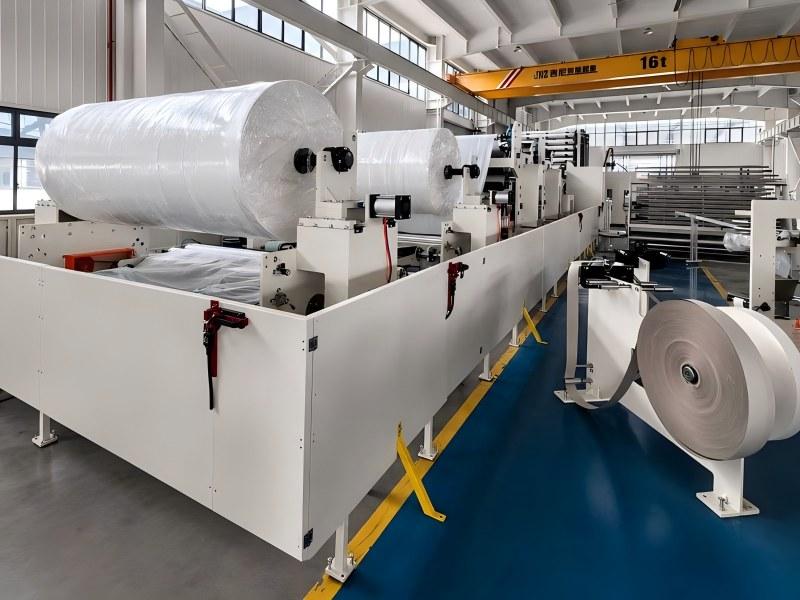
Paper travel at the feed and finished napkin count at output are different measurements.
Count each physical product once
Ask whether the advertised sheets/min figure is a machine total. If it is, multiplying it again by the number of output decks would count the same capacity more than once. Where figures are given per stream or per deck, the proposal should identify the participating outputs and the basis for combining them. Keep a total distinct from its component counts.
A collection deck describes an output position. The number of decks alone does not establish how paper is divided, how counts are accumulated or whether every output is active for the ordered format. The supplier can explain that arrangement without the buyer inferring it from a gallery photograph. An inactive output should not quietly remain in a capacity calculation.
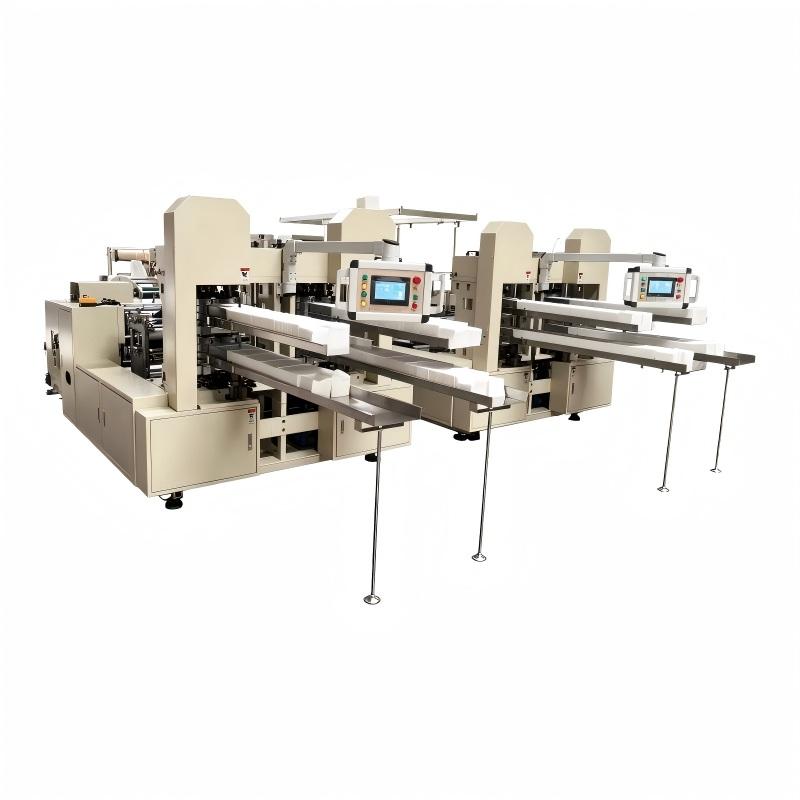
This separate-model DB-NK-230 view illustrates the four-deck arrangement listed for that model; it is not a DB-NK-260 configuration or a rate test.
For an order involving several napkin formats, attach the counting convention to each configuration. A common model name does not ensure that a different fold or sheet size uses the same calculation. The resulting rate comparison should show the actual format and participating outputs, with unresolved arrangements left uncalculated.
Keep a rating separate from a recorded result
A catalogue range supports an initial equipment discussion. A recorded production result needs a product identity, an operating condition and a stated observation period. Label which kind of number is being supplied. The DB-NK-230 page's use of a working-speed label does not turn its entry into a test record for the buyer's particular paper, fold and embossing selection.
For a proposed rate review, identify the finished napkin, paper ply and grade, selected fold and embossing arrangement. State what product is counted and where the count is taken. If only one output is observed, say so. A count presented without these conditions is difficult to compare with either a machine-total rating or a count from another format.
Also state whether the figure covers running time or an elapsed period that includes interruptions. Both may be useful, but they answer different questions. Report the count of accepted napkins separately from all napkins formed if the order uses quality acceptance criteria. This clarifies the number without claiming an unperformed continuous-production demonstration.
When two reported figures disagree, first check their definitions. One may count tissue layers while another counts complete napkins; one may cover a single output while another covers the whole machine. Resolve that disagreement before seeking an explanation in machine performance. No setting change can make two differently defined quantities directly comparable.
Return the quotation with its units intact
Keep linear speed, theoretical sheet rate and any proposed accepted-output requirement in separate fields. Beside each one, identify the product, counting scope and evidence expected. Ask the supplier to explain any conversion used in the offer and to leave unsupported format combinations open for confirmation. This allows purchasing to compare the figures without turning a calculation into a guarantee.
The DB-NK-260 remains the primary equipment reference. Its ordered format and counting scope belong beside every quoted rate.
The useful buying result is a rate that can be read unambiguously: paper travel at a defined point, napkins counted once across the confirmed outputs, and a clear distinction between published capacity and a demonstrated order condition. Preserve those definitions when the format changes or another model is compared. They give the production team a meaningful number to discuss instead of a larger figure created by mixing units.



 Tel: +8613908196540
 Email: info@doubletissuemachine.com
 MP/WhatsApp: +8613908196540
 Manufacturer Address:Dongguan, Guangdong, China