A tissue log saw machine can have a suitable cutting range and still leave two practical questions unanswered: what presents the folded log at its entrance, and what receives the separated stacks at its exit? Those questions belong on the connected equipment drawing. An overall machine photograph cannot settle the direction of a particular tissue product, its transfer height or the responsibility for the short section between machines. Before ordering a standalone saw, describe both handovers as physical boundaries with named suppliers on either side.
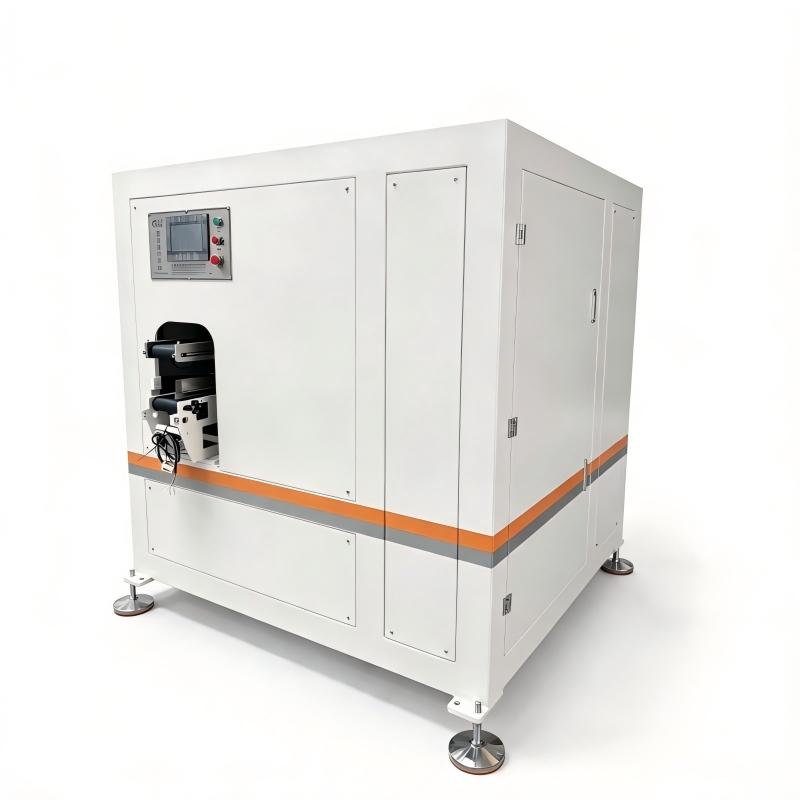
An enclosure view published in the DB-L-320C gallery. The photograph gives equipment context, not a dimensioned drawing of the entrance and exit supplied with an order.
Start with two product states
The DOUBLE DB-L-320C facial tissue log saw is listed for soft-pack facial tissue logs. Its specification describes servo synchronous belt feeding, rotary cutting and automatic head and tail trimming with waste recovery. The page also offers customized feeding and positioning, connections to upstream converting equipment and integration with downstream packing. Those are separate matters to resolve for the proposed installation; their presence in a product description does not identify the equipment included in a particular quotation.
At the entrance, show the folded log as the supplying machine presents it. At the exit, show the cut stack in the state required by the next operation. Use a separate sketch for each. Include the intended product orientation, the supported surfaces and the point at which the receiving equipment takes control. These are proposed drawing fields, rather than claims about a standard DB-L-320C transfer arrangement.
Keep the retail pack beside the drawings as a reference, without using its outside dimensions in place of the paper product. A wrapper can hide the faces that a transfer device must support. The interface discussion needs the actual folded material at each boundary, including its intended count and condition, before it needs a photograph of the finished printed pack.
At the entrance, identify the last support
Ask the supplying equipment vendor to mark the final point that supports or guides the incoming folded log. Ask the saw supplier to mark the first receiving point in its proposed arrangement. Place both marks on the same layout revision. A gap drawn between two rectangular machine outlines is not enough information to decide whether the transfer is included, needs an additional device or requires a revised positioning arrangement.
Record elevation against one site datum. The useful comparison is between the actual product-support surfaces at the connection, not the maximum heights of the two machines. Include the viewing direction on any detail drawing so that an elevation at the entrance cannot be mistaken for an elevation at the exit. A common datum also gives the installation team a reference when the floor level is different at adjacent positions.
Describe how the log reaches that boundary: the named supplying machine, product orientation and intended presentation. Where the current proposal leaves the transfer method open, leave it visibly open in the drawing register. A buyer should not convert a gallery image into an assumed conveyor specification merely because its shape seems to fit the available space.
Material condition belongs in the same discussion. Identify the paper supply, ply construction and folded product reference associated with the proposed handover. If the log arrives compressed or supported in a particular way, ask the equipment suppliers to describe the expected condition in their response. This is an information request, not a recommendation to change compression, feeding pressure or any running adjustment.
A retained machine makes this exercise particularly useful. Its current outlet may have been arranged for manual collection or for a different receiver. Record the existing equipment's actual connection, then ask which changes the proposal includes. Do not assume that retaining the folder also means retaining every piece of handling equipment beside it. The equipment list and the drawing should give the same answer.
Keep a record beside the drawing.
A short interface record can sit beside the layout instead of becoming another general machine checklist. Its job is to capture the details that otherwise fall between two quotations. The following headings are a suggested way to organize that record; their values must come from the suppliers reviewing the actual product and site.
Boundary field
Entry question
Exit question
Product state
What folded log is presented?
What separated stack is released?
Support and orientation
Which surface and face arrive first?
Which faces must remain accessible?
Physical connection
Where does the supplier's support end?
Where does the receiver's support begin?
Delivery responsibility
Who supplies the joining equipment?
Who confirms the receiving arrangement?
Give the record its own reference and link it to the relevant layout. When one vendor replies with an annotated drawing, circulate that revision to the other vendor. Otherwise, two individually reasonable answers can describe different product positions. Ask each party to acknowledge the same boundary definition, including any remaining questions, rather than collecting separate statements that a connection is possible.
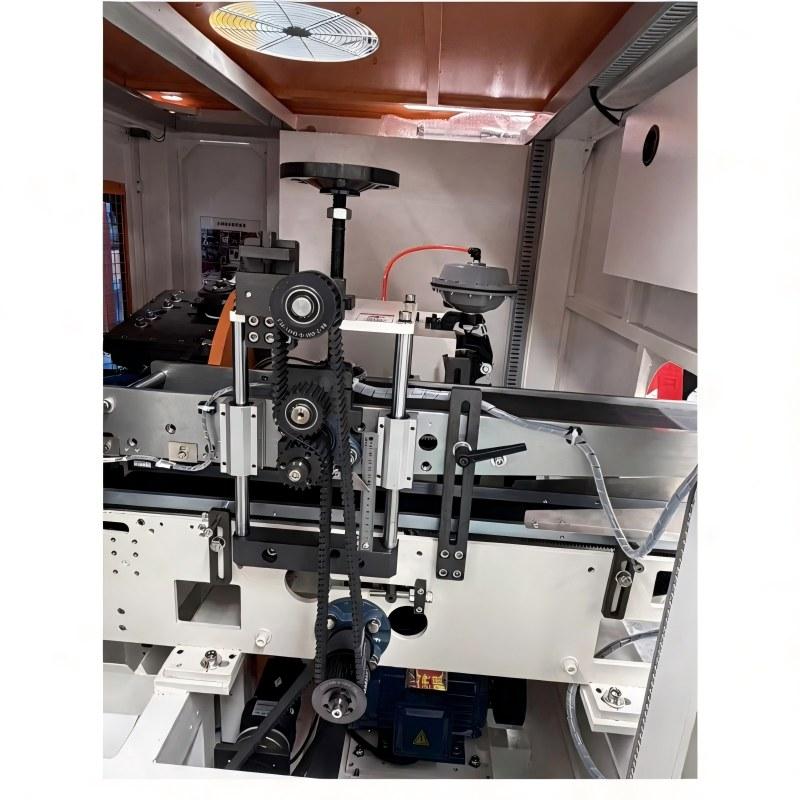
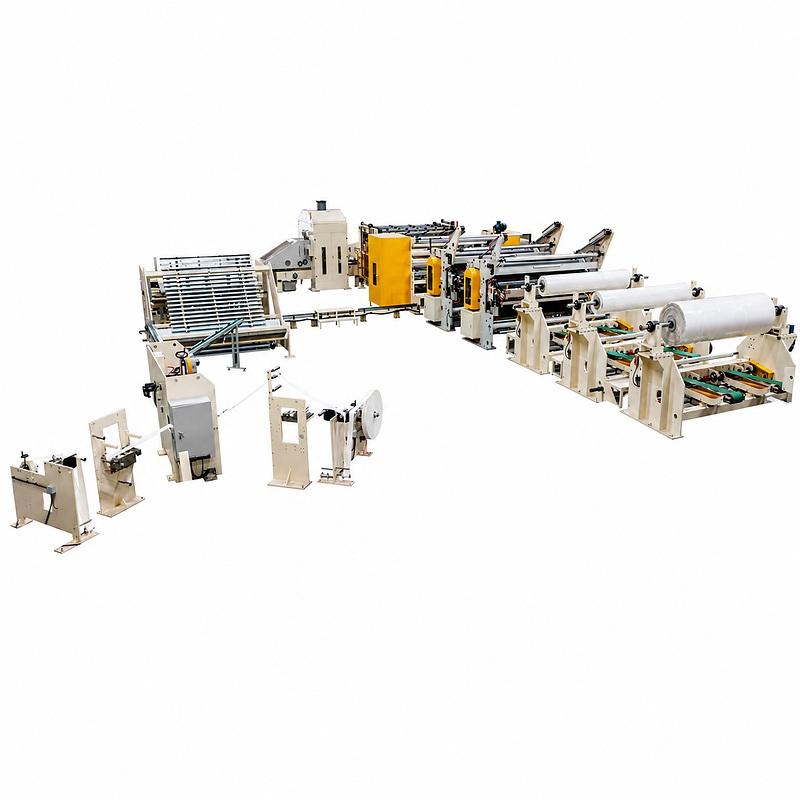
Belts and frame details appear in this DB-L-320C gallery view. Their exact drive function and an ordered transfer configuration cannot be established from the picture.
At the exit, work back from the receiver
The packing supplier should identify the stack it expects before the saw supplier fixes the outlet arrangement. Ask for the receiving product position, required orientation and the named point of acceptance. Keep these requirements attached to the particular packing equipment. A general statement that the saw connects to packing equipment does not show whether the proposed receiver needs one stack at a time or another presentation.
Discuss count and continuity without assuming that a cutting-speed rating answers either. The DB-L-320C page gives a maximum of 320 cuts per minute. That number is not a published statement of accepted retail packs per minute at the end of an unspecified line. The suppliers need to explain how the selected log, trimming arrangement, cut stacks and receiving process relate in the proposed connection.
Ask how the receiving equipment's availability is communicated to the supplying equipment, and who supplies any agreed connection controls. The product page lists PLC control, servo drives and an HMI, but does not provide a complete interface signal list for every installation. Request the actual agreed description rather than naming signal types, protocols or automatic recovery behaviours that have not been specified.
Keep an interruption discussion focused on responsibilities. Who describes the agreed response when the receiver cannot accept another stack? Which supplier provides the operator instruction for restarting the connected equipment? These are questions for the line designers. They do not authorize a buyer to devise a control bypass or an improvised method of collecting material around moving equipment.
There may also be a commercial boundary inside what looks like one physical connection. One vendor might supply a conveyor while another supplies its controls or installation. Request those responsibilities in plain language, including who resolves a disagreement at commissioning. The buyer does not need to design the connection to insist that the offer names a responsible party for the complete agreed function.
Reserve space for what the catalogue excludes
The published machine dimensions are 1600 × 1650 × 1700 mm, expressly without the infeed conveyor. That exclusion matters when a buyer places the saw on a floor plan. The rectangle described by those dimensions cannot stand for the entire connected entrance, and the page does not give a universal length to add to it.
Request the proposed infeed outline, outlet connection and installation arrangement before releasing the space reservation. Keep product movement, material access and supplier-required service space visible on the drawing. Let the responsible supplier confirm those provisions for the delivered configuration; a blog or a gallery photograph cannot supply the required clearances.
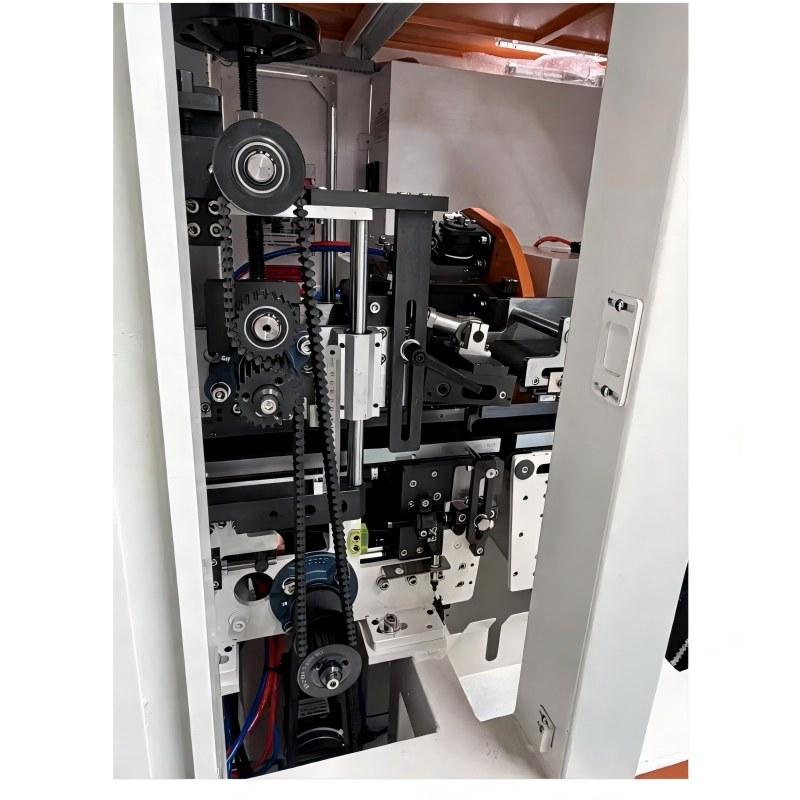
A second front angle from the product gallery. Open-housing imagery is for identification and context, not an instruction for access or operation.
Release the interface with the equipment order
Before the purchase specification is closed, attach the entrance sketch, exit sketch, interface record and common layout revision to the order scope. Name the supplier responsible for each connecting item. If an existing machine is retained, identify it by the actual model and available drawing rather than a broad description such as existing folder or existing wrapper.
Keep unresolved dimensions and connection controls in an open-items list with an owner. The useful outcome is a join that both sides have reviewed against the same tissue product. It allows the saw, the entrance equipment and the receiver to be assessed as a connected proposal while preserving a clear boundary around what each supplier is actually delivering.
During the later drawing review, check the interface references again whenever either neighbouring machine changes. A substitution described as equivalent may keep the same product range while moving a transfer position. Ask whether the accepted entrance and exit records still apply. This keeps the discussion tied to a physical join, rather than assuming that matching catalogue categories guarantee a matching connection.




 Tel: +8613908196540
 Email: info@doubletissuemachine.com
 MP/WhatsApp: +8613908196540
 Manufacturer Address:Dongguan, Guangdong, China