A cutting accuracy figure becomes useful only when two people can measure the same stack and explain the same result. For a folded tissue log, the measured face can move under handling pressure, and an uneven edge can invite several different readings. Before discussing whether a tissue log saw machine meets its published accuracy, agree what is being measured, how the sample rests and which observation will be compared with the limit. This is a measurement agreement for a purchasing discussion, not a report of a completed machine trial.
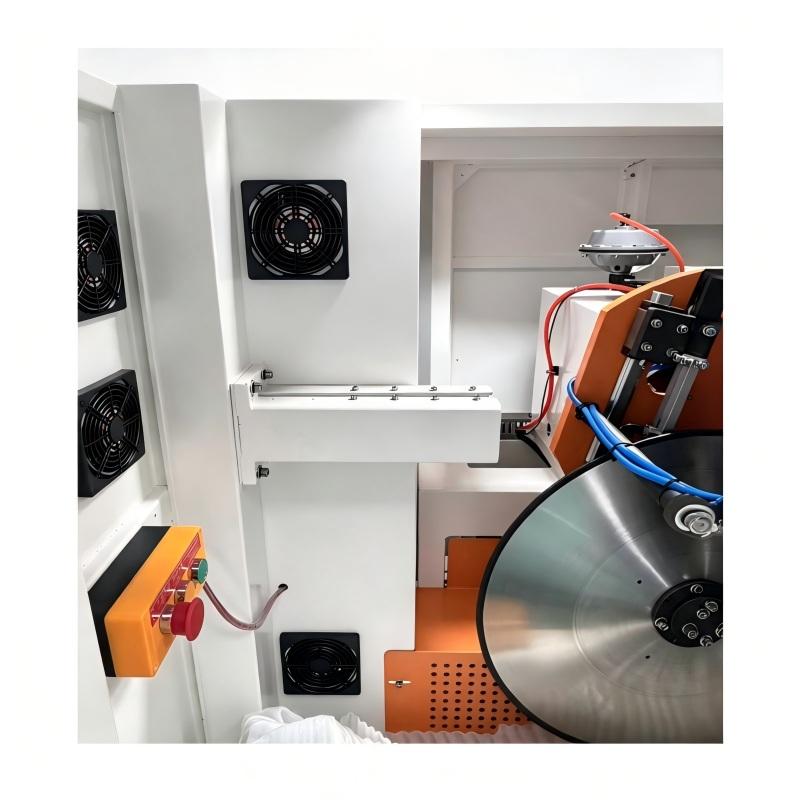
A detail published in the DB-L-320C gallery shows a circular blade within the housing. Dimensional evidence comes from identified product samples, not this photograph.
Put the accuracy beside an identified dimension
The DB-L-320C facial tissue log saw page lists cutting accuracy of ±1 mm for soft-pack facial tissue logs. It also lists a maximum cutting rate of 320 cuts per minute. These are separate catalogue statements. Neither tells a buyer which sample points were measured, how long a trial lasted or what share of a particular order's stacks met a dimensional requirement. Those details need a written agreement tied to the proposed product.
Start with a drawing of the cut stack as it will be received after cutting. Give the proposed cut dimension one name and identify its opposing reference faces. Do not attach the accuracy figure to stack height, folded sheet width or the outside wrapper simply because all appear on the same finished-product sketch. The supplier should identify the dimension to which its cutting statement applies, with the nominal value and any order-specific qualification beside it.
The published size range uses the labels L90–250, W80–110 and H25–120 mm. Preserve those labels when discussing the catalogue. They do not establish a tested combination at every extreme or settle the measurement direction on the buyer's drawing. A returned drawing should connect the selected product to the source labels before anyone writes a pass or fail entry.
Describe the stack's condition at the bench
A folded tissue stack is a compliant object. A useful measurement note therefore describes its state, not just its nominal dimension. Agree whether the sample is measured directly after collection or after a stated resting period, whether any package has been removed, and how the stack is supported. Record the selected procedure rather than allowing each observer to straighten or compress the tissue until it looks easy to measure.
Ask the supplier to propose a suitable instrument and contact method for the agreed faces. This article does not prescribe a measuring force or a universal instrument resolution. The relevant question is whether the chosen method can distinguish the agreed dimensional differences without changing the sample in an uncontrolled way. If a contact surface compresses the stack, the method should explain how that contact is kept consistent.
Separate loose protruding tissue from the reference face in the method's definition. One observer may read the furthest visible fibre while another reads the apparent cut plane. Both can believe they have measured the same length. Have the parties resolve that interpretation on a physical reference sample and photograph the reference orientation. The photograph supports the description; it is not a substitute for the dimension reading.
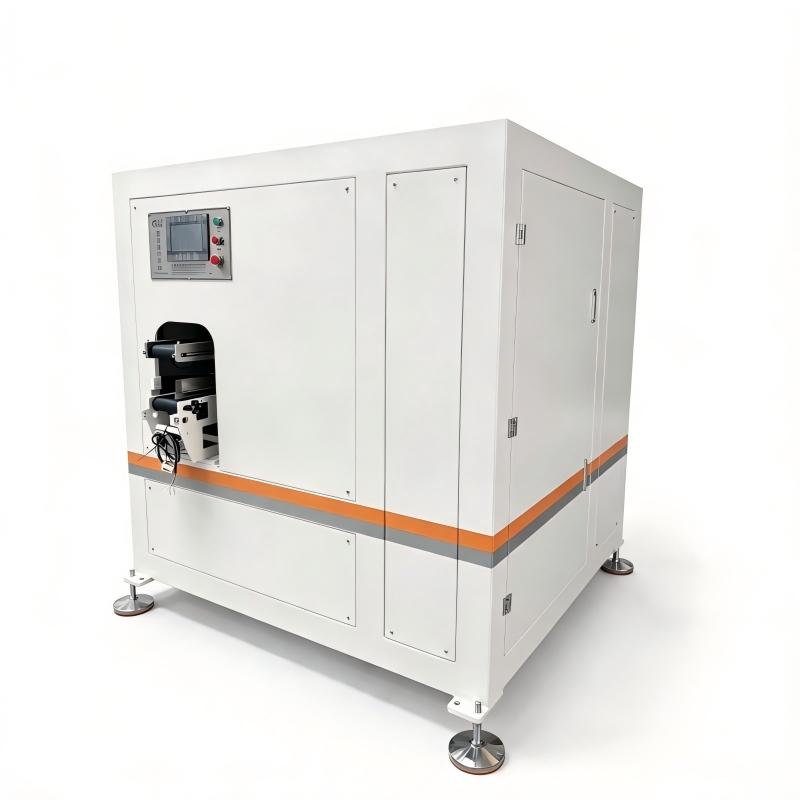
The overall enclosure view supplies equipment context. It does not identify the selected cut dimension or the conditions behind a catalogue accuracy figure.
Give every reading enough context to be checked
Use a small dimensional record that another person can follow later. A sample identity, the target dimension, the actual reading and the measurement method should stay together. Keep the signed difference from nominal rather than recording only an absolute deviation. A mixture of readings above and below target tells a different story from readings that all sit on the same side, even when their average absolute difference is similar.
Record field
What it preserves
Sample and collection identity
Which stack was measured and where it came from
Drawing revision and named dimension
The nominal value and the faces being compared
Resting and support condition
The agreed physical state during measurement
Reading and signed difference
The result before any summary calculation
Observer and instrument reference
Who made the observation and with which method
The table is a proposed purchasing record, not evidence that the machine automatically stores these fields. A handwritten sheet can serve the purpose if the entries remain traceable. If readings are entered electronically, retain the original observations as well as the final summary so that a mistaken transcription can be corrected without losing the earlier entry.
Record a missing or unreadable observation as such. Replacing it with the target value would make the data look complete while removing the uncertainty that matters. Likewise, a damaged sample should keep its identity and the reason it could not be measured. A replacement sample can be collected under the agreed plan, but it should receive its own entry rather than silently taking the first sample's place.
Check the method before interpreting the machine
Before using a large group of readings, ask two observers to measure a small identified set by the proposed method. This is a suggested check of the measurement agreement. It is not a claim about any customer's test. Compare the individual readings, discuss differences and determine whether support, contact or reference-face interpretation needs clarification. A disagreement at this stage may concern the method rather than the saw.
A repeat reading also needs a handling rule. If the first measurement squares the tissue against a stop and the second measurement uses the reshaped stack, the two observations no longer represent identical conditions. Agree whether repeated readings use the same untouched sample, a defined repositioning procedure or separate samples. Note the choice, and avoid treating these approaches as interchangeable evidence.
Once the parties can apply the method consistently, agree which production samples will be collected. Identify the selected paper and folded-log format, and state how samples from the agreed observation period will be selected. A collection chosen only because every stack looks neat cannot support a statement about the whole period. The selection rule should exist before the readings are known.
Leave room for a doubtful boundary reading
A reading close to a selected limit deserves more explanation than a rounded number alone. Agree the reporting precision and retain the instrument's original reading where available. If one person rounds before calculating the difference and another rounds afterward, they may assign different dispositions to the same sample. The purchase agreement should explain how a boundary result will be handled rather than leaving the decision to an improvised spreadsheet formula.
Ask the people responsible for the measurement method to identify the uncertainties relevant to the compliant sample and chosen instrument. An instrument's displayed resolution is only one part of that discussion. Support, reference-face interpretation and repeat handling can also affect the observation. This does not supply a numerical uncertainty allowance; it identifies information the parties need before treating a marginal result as conclusive.
Keep instrument identity and its appropriate verification record with the measurement sheet. If the device is replaced midway through collection, mark where the change occurs and why. Do not merge the two groups without retaining that distinction. A later investigation can then examine whether the readings are comparable without relying on somebody's memory of which ruler or gauge happened to be on the bench.
A photograph of the measurement arrangement can help another observer reproduce the viewing direction and sample support. Include the sample identity and drawing reference in its record. Perspective and image scaling still prevent the photograph from becoming a precision measurement on its own. Its role is to document the agreed method, while the dimensional sheet preserves the actual observations used in the decision.
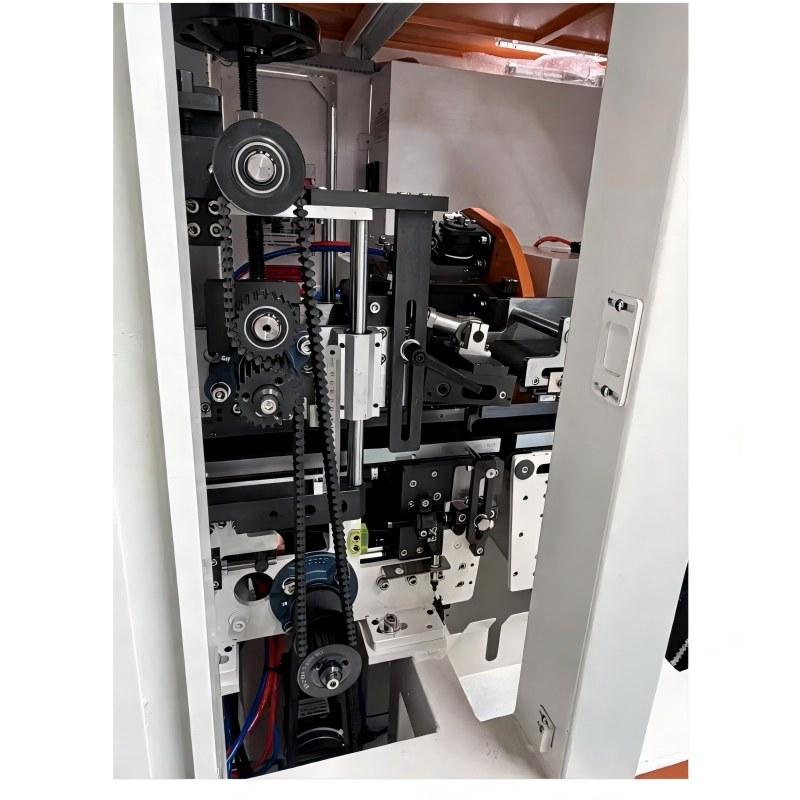
Belts and gears are visible in this source-gallery detail. Their appearance does not establish a reason for a dimensional deviation or an adjustment to make.
Agree how the readings will support acceptance
A mean alone can hide individual readings beyond a stated boundary. Conversely, one isolated reading without its method and sample condition may be insufficient to explain the result. Ask the supplier and buyer to agree the decision rule, the sample plan and the treatment of doubtful readings before an acceptance exercise. No universal sample size or statistical confidence is supplied by the catalogue accuracy statement.
Keep any visual cut-quality assessment separate from the dimension record. A stack may meet the agreed length while having an appearance issue that needs another inspection criterion. It may also look square while measuring outside a selected limit. List those observations independently so that an attractive face is not counted as dimensional evidence and a dimension result is not mistaken for a complete product-quality assessment.
When a result needs investigation, preserve the readings and reference samples for the responsible supplier. Record what was observed before suggesting a cause. The published servo feeding, rotary cutting and automatic sharpening features do not diagnose a particular deviation. A useful dimensional discussion ends with a reproducible observation, an agreed comparison and a clearly identified unresolved question.






 Tel: +8613908196540
 Email: info@doubletissuemachine.com
 MP/WhatsApp: +8613908196540
 Manufacturer Address:Dongguan, Guangdong, China